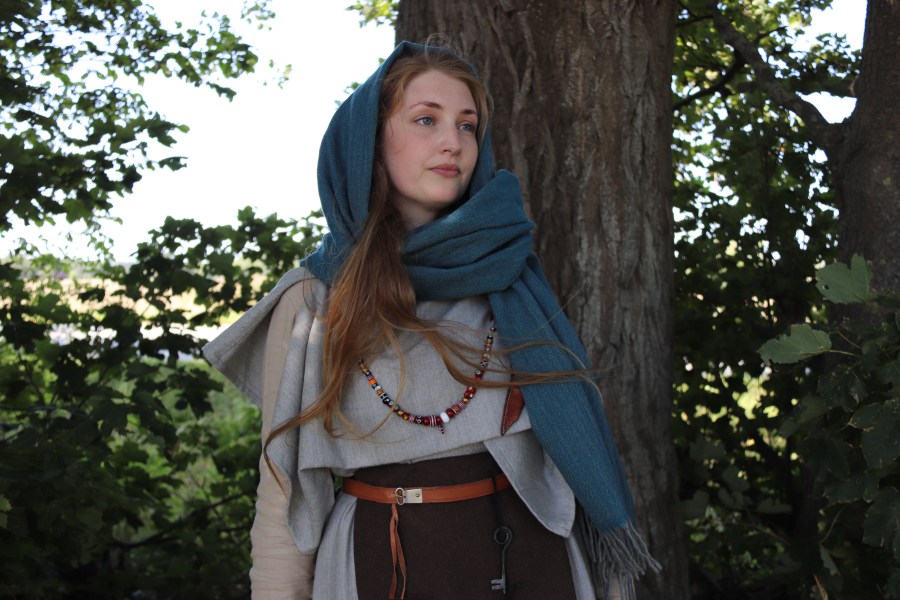
I would like to dedicate this post to my dear friend and former colleague, Daniel, who sadly passed away on the 19th of May 2015. Daniel, you always followed my work and read my posts, gave me feedback and inspired me to keep on working. You asked questions and motivated me to work harder, to do an even more thorough job, to research more. You made it more enjoyable to write, to do crafts and to take pictures. Thank you for that. You are deeply missed!
Content
¤ Introductions
¤ Lovön
¤ Burial site Raä 13, Söderby, Lovön
¤ My interpretations
– A39: Brooch, glass beads, bronze beads
– A13: Knife
– A32: Belt buckle
¤ Burial site Raä 27, Lunda, Lovön
– A30: Garment pins
¤ My garments
¤ Summary and reflections
¤ Sources
Introductions
When I first decided to make a Vendel period kit back in 2018, I had no clue where to start. I didn’t know what geographical area to choose, nor where to start looking to get access to articles and reports. Luckily, I have my own Vendel period expert who could and wanted help me.

Christofer quickly guided me towards a Swedish island called Lovön and the huge number of burial sites and graves located there. There were so many graves and I had no idea which one to pick. Eventually I ended up basing my Vendel period kit on a grave called A39 from a burial site called Raä 13. This grave ended up being the base for my kit. I also used elements from three other nearby graves to give some fullness to my interpretation. Three of the four graves are located in the same burial site, Raä 13, while the fourth is from a burial site called Raä 27, located very close by. All four graves are from the same period, with a maximum of a few decades between them.
In this article I will go into details about both burial sites, the different graves and the various objects from the graves that has been reconstructed for this interpretation. I will also compare the different objects in my kit to other similar and contemporary finds. In addition, I will give you an insight into how I have been working with this project, how I’ve been thinking, what challenges I have faced and what I have learned.
Lovön
The island of Lovön measures about 23 km², and is located in the eastern parts of Mälaren, not far from the city of Stockholm. It is also very close to Birka, located at Björkö, and other historically important places located in and around Mälaren such as Adelsö and Sigtuna.

Photo: I99pema (CC BY-SA 4.0)
Lovön has a high cultural and historical value with its large concentration of cultural heritage sites, not only from the Vendel period, but all the way back to the Bronze Age and all the way up to modern times. The island also holds a lot of cultural landscape and a nature reserve. Drottningholm castle is among the most famous places on the island. The royal castle is from the 1600’s and is today the resident of the Swedish royal family. The area has been on the UNESCO World Heritage List since 1991.
Lovön is divided into 14 smaller areas with individual names. These different areas and their names are important when it comes to naming the different burial sites on the island. More than 45 burial sites have been registered and they are distributed among these 14 areas. The areas with the greatest concentration and the largest collection of burial sites, are Söderby, Lunda and Berga. In these three areas there are about 16 registered burial sites, with around 1007 registered individual graves. Since 1958 about 340 burials from the early Iron Age have been examined in Söderby, Lunda and Berga.
Due to it being such a large number of burial sites and graves, each site has been given its own name (Raä 34, Raä 118, Raä 16, Raä 13 and so on) to make it easier to distinguish between them. Each grave in these different burial sites has also been given individual names – starting at A1, continuing up to the total amount of graves that has been excavated in each site. This makes it very easy to refer to a specific grave or a finding within a grave within the burial sites. So, if I wanted to tell you about that really interesting child burial from Viking age with 600 beads in it, I would do so by referring to it like this: Grave A31, Raä 13, Söderby.
In the illustration below you can see the different areas and the different burial sites marked as black shapes.

Lovön and the different burial sites. You can see Berga, Lunda and Söderby above the the big bay area made from the peninsula called Lindö. Drawing from “Gravfältet Raä 13 Söderby, Lovö SN Uppland – Ett gravfält med två familjer från yngre järnålder” by Bo Petré. Stockholm: Department of Archaeology, 1999.
For my interpretation, I ended up picking four graves from two different burial site, but with the main focus being on A39 from burial site Raä 13. I chose to incorporate the other three graves to get a fuller interpretation. It is worth mentioning that these burials are all cremation burials, which means that the material found is somewhat reduced or limited.
I will now take a closer look at these two burial sites and the four graves that I chose to use for my interpretation. I will be presenting burial site Raä 13 first and the three graves which I chose within this burial site. For each of the graves I will also present my interpretations of each object. Further, I will do the same with the grave that I chose from Raä 27. I will also look at similar findings from other burial sites or graves in an attempt to see whether these objects have a particular intention.
Burial site Raä 13, Söderby, Lovön
Burial site Raä 13, located at Söderby, was excavated between 1978-1991. The archaeological excavation was led by Bo Petré.

The illustration is borrowed from “Arkeologiska undersökningar på fornläning Raä 34, Lunda/Berga, Lovö sn, Uppland – Gravfält från vikingatid, äldre järnålder och yngre bronsålder samt boplatslämningar från bronsålder” by Bo Petré. Here you can easily see the Raä 13 burial site and Raä 27. The distance between the two sites is not far, only a few hundred meters.
During the excavations of Raä 13, they found 45 graves with at least 47 different individuals in them. Three of the graves were mounds, 40 were circular graves with stones on top, and one of the graves was a mound-looking grave with stones on top of it. Three of the graves (A35, A37 and A38) were dated to Late Bronze age. These three graves are located in the western part of the burial site, some distance from the other graves. They are not showing in the illustration below. The rest of the 42 graves were dated to the years between 490 – 900 AD. Most of the 42 graves are from the Migration period and the Vendel period. The Migration and Vendel period graves are all cremated graves, which was very common for these two periods. A few of the graves are from the Viking period. These are not cremated graves, because burial customs had changed by then.
During the excavation, the archaeologists also found a road, remains of cooking pits and agricultural fields. Underneath some of the graves they found traces of one settlement from the Late Bronze age and one from the Early Bronze age. They also found some tools made from flint, one made from quartz and lots of pieces of ceramics dating to the Bronze age.
A whole series of tests and research have been done on the Migration, Vendel and Viking period graves. The individuals in these 42 graves have been tested for DNA and genealogy to see if they are related in any way. Results from these tests shows that the oldest graves out of the 42 Migration, Vendel and Viking period graves is representing one core family. A division of the family happened after about three generations, when the original core family seems to have split into two core families. A reason for this could have been that two brothers, who both got married, started their own families and separated into two independent households. The two families may have lived closed to each other with their separate households, houses and animals, and they would probably have had some sort of agreement when it came to land, rules, etc. They would continue to bury their dead in the same burial field, but in different parts of the field.
The burial site is divided into five parts, the north-west, the west, the middle, the east and the south part. The middle part is the oldest, and this is where the original core family is buried. The burial site then grew outwards from the central part. The graves from the Bronze Age are not included in this context.
I will return to these two brothers, their wives and the two core families later.
In the picture below, you can see the five parts of the burial site, with the central part in the middle marked as “MITT”. The three graves I have chosen for my interpretation is located in the west part (A13), the middle part (A32) and the east part (A39).

In the picture you can see the different parts of the burial site Raä 13. The arrows show how the burial field grew outwards from the middle part. Drawing from “Gravfältet Raä 13 Söderby, Lovö SN Uppland – Ett gravfält med två familjer från yngre järnålder” by Bo Petré. Stockholm: Department of Archaeology, 1999.
My interpretations
Although my kit consists of objects from four different graves, two of the graves, graves A39 and A30, constitute the most important part of my kit. Some of the items from these two graves are most likely directly related to the garments and therefore had an important role in the determination of what type of garment I would use in my interpretation.
I will now be looking closer at the individual graves and the different objects found in each grave.

Me wearing my Lovö kit for the first time at Uppåkra 2018.
Grave A39, Raä 13
Grave A39 is a circular grave with stones placed in a circular formation on top of it. Before they started the excavation, the grave was visible as a slight elevation in the ground with a few visible stones. The grave measured 2,2 meters in diameter and was about 10 cm high before they started to excavate it. There was a visible rounded grave orb or stone orb measuring 19 cm x 32 cm standing in the center of the grave (not showing in the drawing below). Grave orbs were probably placed on top of a grave to mark it. If it had any other significant meaning, we don’t know for sure, but a lot of experts believe that it may have something to do with fertility. Not all of the graves at the burial site have a grave orb, but those who does seems to have belonged to women. The presence of such a stone has therefore been important in the gender determination process, where it has otherwise been difficult to determine the gender of the person in the grave based on bone examinations and the objects in the grave.

A section of Bo Petré’s drawing from “Gravfältet Raä 13 Söderby, Lovö SN Uppland – Ett gravfält med två familjer från yngre järnålder” by Bo Petré, Stockholm: Department of Archaeology, 1999. In this picture you can also see the placement of the two pieces of the brooch as they are marked as two black dots.
When they opened the grave, they first found a lot of charcoal and burnt bones. As they continued to examine the grave, they found two pieces of an equal-arm metal brooch (1), five beads made from bronze wire (2), two cast bronze beads (3), 33 glass beads (4), 20 pieces of fragments of a bone comb (5) and fragments of ceramics (6). Later analysis showed that some of the bones found in the grave came from a goat or a sheep. In other words, the person in the grave got a goat or a sheep with them in the grave.

Drawing from “Gravfältet Raä 13 Söderby, Lovö SN Uppland – Ett gravfält med två familjer från yngre järnålder” by Bo Petré. Stockholm: Department of Archaeology, 1999.

A section of Bo Petré’s drawing from “Gravfältet Raä 13 Söderby, Lovö SN Uppland – Ett gravfält med två familjer från yngre järnålder” by Bo Petré. Stockholm: Department of Archaeology, 1999.
The grave is dated to the first half of the 500’s and is categorized as a very early Vendel period burial or a very late Migration period burial. As this is a cremated grave, there are not much left of the person inside the grave or their belongings. There are no traces of fabric, only bones, charcoal and the objects mentioned above.
At first, they believed that the grave belonged to a male. The reason for this was that the first osteological analysis came back showing that the remains probably belonged to a male. Even though the analysis showed a male individual, the experts were not entirely convinced. The objects found inside the grave and the grave orb indicated that this was the grave of a woman. Later osteological tests showed that this was indeed a woman, and it was then finally determined by the different factors; the objects (mainly the beads and the brooch), the grave orb, and the new tests of the bones. They also found that the woman had been between the age 18 and 44 years old when she died.
As this grave constitutes the main part or the base of my reconstruction, I have decided to reconstruct all items found in the grave. As for now I have the equal-armed brooch, the glass beads and the two types of bronze beads reconstructed. The comb and the ceramic vessel will be made at a later occasion.
I decided to have two of the equal-armed brooch made for me. I will explain why further down in the text, in the part about my garments.
The brooch
In grave A39 they found two pieces of a broken brooch. In the report, Bo Petré states that the two pieces was found with a distance of 45 cm from each other. It seems Bo Petré interpreted this as one brooch that was broken and found in two pieces, rather than it being a pair of brooches of which only a part of each was found. The pieces were in a pretty bad shape. You can clearly see part of a needle on one of the pieces. It is also easy to see that both of the pieces are from either the same brooch or a pair of equal-armed brooches. There is also a visible pattern on both pieces, although the pattern on one of the pieces is clearly more obvious.

A section of Bo Petré’s drawing from “Gravfältet Raä 13 Söderby, Lovö SN Uppland – Ett gravfält med två familjer från yngre järnålder” by Bo Petré. Stockholm: Department of Archaeology, 1999.
The characteristic of equal-arm brooches is that the head and foot of the brooch are equally shaped and sized. In both Swedish and Norwegian context these type of brooches were quite common in Early Iron age graves. Another thing that is typical for equal-armed brooches from this period, is that most of them have some sort of ornamentation, lines and dots are fairly common.
There are four other graves within burial site Raä 13 that also contain equal-armed brooches, all single ones, if I am not mistaken. In the other burial site I have been working with, Raä 27, they found 11 (maybe 13) equal-arm brooches divided into 8 graves. This means there are three or five graves with pairs of equal-armed brooches. Again, note that these are cremated graves, and this might have affected what remains in the graves. There might also be other, to us unknown, reasons why there might be only one brooch. I will come back to the brooch later as this is one of the objects that helped decide what kind of clothing I would choose for my interpretation.
In Uppåkra, further south in Sweden, a total of 68 brooches, dating to the early Vendel period, was found during a huge excavation. This is the largest collection of equal-armed brooches found in one place in Scandinavia. The brooches found in Uppåkra seem to have been used in pairs and their function is believed to be related to the clothes, most likely to hold garments together at the shoulders.


Some different equal-armed brooches found around Sweden, dated to the Vendel period. Brooch number 2, 3 and 4 are found not very far from Lovön.
Photo 1: 406990_HST, Östergötland, Sweden, photo by Eva Vedin, SHM
Photo 2: 14722_HST, Södermanland, Sweden, photo by Victoria Dabir, SHM
Photo 3: 488863_HST, Södermanland, Sweden, photo by Gabriel Hildebrand, SHM
Photo 4: 142571_HST, Uppland, Sweden, photo by Sara Kusmin, SHM
Statens historiska museum/SHM, CC BY 4.0
Not so far from Uppåkra, at a place called Augerum, also south of Sweden, they found a boat burial with several equal-arm brooches. Two of these brooches had fragments of linen fabric inside them. They also found another, larger type of brooch which had fragments of wool fabric on it. At both Uppåkra and Augerum they also found some fragments of cord or string inside some of the brooches.
Also in Norwegian context, the equal-armed brooch seems to have been quite common. Some of them have been found in pairs, but most of them are found alone. One of the reasons for this may be that they are often found in agricultural landscapes. The soil here is plowed repeatedly, and finds often come to the surface now and then, often resulting in stray finds. Stray find is the archaeological term for finds of archaeological objects where there are no further information about the conditions and context of the find. More recently, metal detector searches have also resulted in more finds. We will in other words probably see even more brooches like these in the years to come.


Examples of two contemporary Norwegian equal-arm brooches which are similar to the pieces found in grave A39, Lovö.
Photo 1: T27295, Møre og Romsdal, Norway, photo by Caroline Fredriksen
Photo 2: T27314, Møre og Romsdal, Norway, photo by Ole Bjørn Pedersen
NTNU Vitenskapsmuseet, CC BY-SA 4.0
I’ve also looked to some contemporary Anglian graves. A study done on 113 graves showed that 67 of the graves had small, identical pair of equal-armed brooches found on each side of the upper body, around the shoulder area. Here the equal-arm brooches have been interpreted to have pinned together and held up a garment called a peplos. More about the peplos further down, about the garments.
In the same research, they also found that a bigger brooch often was holding together a cloak over the peplos dress. In Uppåkra they also found a bigger and heavier type of brooch in connection to the smaller equal-arm brooches. This type of brooch may have been placed between the equal-arm brooches to hold together a clock or some other garments.
Here is how my equal armed brooches turned out.

One of my equal-armed brooches, interpretation based on the brooch found in A39. It is holding up my peplos at the shoulders.
The glass beads
All the beads that I have for this kit, both the ones made from glass and the ones made from bronze, are interpretations from the ones found in grave A39, Raä 13. The beads are all located at Historiska museet today, but none of the beads are on display as far as I know. In order to see them I had to contact the museum and they were very helpful and took some great pictures for me.
During the excavation, they found 33 glass beads in grave A39, four of them were melted together into pairs of two and two. If you count these as separate beads, there are 35 glass beads. Bo Petré wrote the colors of the glass beads in his drawing. According to him, there were three (four if you count the melted beads as two) red ones with white and green decor, four beads are red and white, one is red with white and yellow decor, three (four if you count the melted beads as two) are red and yellow-ish, two are black and white, one is blue with white and red decor, two are white with green and white decor, four are black with white and dark green decor, two are red with white and green decor, one is red with white and green decor, two are orange, two are red, one is white, two are white and red, and one is black and white.

A section of Bo Petré’s drawing from “Gravfältet Raä 13 Söderby, Lovö SN Uppland – Ett gravfält med två familjer från yngre järnålder” by Bo Petré. Stockholm: Department of Archaeology, 1999.
Since grave A39 is a cremated grave, some of the glass beads had melted together, according to Bo Petré, and some were just generally broken. From the picture below you can see the state that the glass beads are in.
Most of the beads looks quite ordinary compared to other contemporary finds. Some of them have line or spiral decorations, some have dots or knobs, some have a zigzag or wavy patterns, some are made with just one color, some have multiple colors. However, one of the beads in particular stands out – the one to the far right in the second line from the bottom in the picture below. It looks a bit like an animal tooth of some sort, but it is made of glass.

These are all of the original beads from A39. Photo by Historiska museet.

This is the first line from the top. Photo by Historiska museet.

This is the second line from the top. Photo by Historiska museet.

This is the third line from the top. Photo by Historiska museet.

This is the fourth line from the top. Notice the one to the far right. Photo by Historiska museet.

This is the bottom line. Photo by Historiska museet.
It turned out to be a bit tricky to figure out which bead was which comparing Petré’s drawing and the photos from Historiska. Firstly, because of the damage on them. How many are melted together? Have some of them suffered further damage after the excavation? Secondly, the fact that we couldn’t go and study them ourselves made it a bit harder to interpret the beads just from the pictures Historiska museet gave me, although the pictures was of great help when the beads were to be recreated. How is the lighting in the photos? How do they look from other angles? How did they originally look before they melted? I spent a lot of time comparing the beads, and after some time studying them, I got to know each individual bead. In the end I felt content with the result.
My favorite bead makers, Paul and Lesya from Pole Glass shop, made the glass beads for me. We went a bit back and forth regarding colors, shapes and such, but I am really happy with the result and how they all turned out. They even made some of them “melted” together as the originals after they were found. Of course, we don’t know if they became like this after the cremation or if they were made like this in the first place. I think very few people have beads like these. I hope to get the chance to visit Historiska museet and see the beads for myself one day soon, so that I can take even better pictures and study them myself. Perhaps I’ll find some new information too.

The interpretations that Pole Glass shop made. Photo by Pole Glass Shop.

The interpretations that Pole Glass shop made. Photo by Pole Glass Shop.
The bronze wire beads
According to Bo Petré, there were seven bronze beads in grave A39 together with the glass beads. Five of them were, according to the drawings and the report made by Bo Petré, made from bronze wire, so-called bronze barrel beads, and two of them were cast ones. In Petré’s drawings, we can clearly see that he drew seven bronze beads, five barrel beads and two round ones. One of the barrel beads is broken, but the rest looks like they are in a rather good shape.

A section of Bo Petré’s drawing from “Gravfältet Raä 13 Söderby, Lovö SN Uppland – Ett gravfält med två familjer från yngre järnålder” by Bo Petré, Stockholm: Department of Archaeology, 1999. I have marked the bronze barrel beads that was broken when found during excavation.
When I received the photos from Historiska museet, there were only six bronze beads in the photos – one of the barrel beads was missing. Why the number of beads differs, I do not know. It looks like the one missing is the one that was broken in Petré’s drawing. Maybe this one was so broken that it didn’t survive or it got lost somewhere along the way?

Here are the six bronze beads together. Photo by Historiska museet.

A closer look at two of the bronze barrel beads. Photo by Historiska museet.
The bronze barrel beads were made with a string or wire from bronze. The ones from A39 is wrapped rather tightly. Beads like these are not very common, but they aren’t super rare either. Here are some examples of beads made from bronze wire, like the ones from A39, both in Swedish and Norwegian context. In the last picture, you can also see an example of glass beads.


Examples of contemporary Swedish bronze barrel beads made from wire:
Picture 1: 375165_HST, Södermanland, Sweden, photo by Eva Vedin, Historiska museet/SHM
Picture 2: 445559_HST, Uppland, Sweden, photo by Victoria Dabir, Historiska museet/SHM
Picture 3: 363191_HST, Södermanland, Sweden, photo by Ulrik Skans, Historiska museet/SHM
Statens historiska museum/SHM, CC BY 4.0


Examples of contemporary Norwegian bronze barrel beads made from wire:
Picture 1: T12253:b, Trøndelag, Norway, photo by Ole Bjørn Pedersen, VM.
Picture 2: T15808:c, Trøndelag, Norway, photo by Ole Bjørn Pedersen, VM
NTNU Vitenskapsmuseet, CC BY-SA 4.0
It was a bit hard to see and determine whether the bronze barrel beads in grave A39 are made from bronze wire, as Petré claims, or if they are actually made from a solid piece with lines just by looking at Petré’s drawings. Historiska museet, however, could confirm that these are in fact made from bronze wire. Compared to other bronze wire beads I’ve seen, they look more like a solid piece of bronze because they were wrapped tightly. The high temperatures might also have melted them a bit during the cremation.
Christofer made the bronze barrel beads for me. He made me four, although there were five found in total. I’ll have him make me the fifth as well on a later occasion.
Instead of making them with bronze wire, he made them solid, even though we knew that they are made from bronze wire. The reason for this was that we didn’t have the proper tools or knowledge at the time to make them as the originals. He instead made them so that they look like the originals, but with a different technique. He now has the correct tools and more knowledge on how to make them as tight.
Here are the bronze barrel beads that Christofer made for me. I think they turned out great.


The cast bronze beads
The two other beads made from bronze in the grave, are so called cast bronze beads. They are very interesting and very beautiful. One of the cast beads is plain with no visible decorations. The other one has distinct lines in it, two horizontal lines and two vertical lines. This makes a very simple, but such a beautiful decoration.

A section of Bo Petré’s drawing from “Gravfältet Raä 13 Söderby, Lovö SN Uppland – Ett gravfält med två familjer från yngre järnålder” by Bo Petré, Stockholm: Department of Archaeology, 1999. I have marked the bronze barrel beads that was broken when found during excavation.
The bronze bead that appears plain is a bit more beaten up than the other one. We had to check with the museum to know if this one also had any indications of lines or any decorations, but it doesn’t have any indications of lines, according to the archaeologist we talked to at Historiska museet.

These are the original cast bronze beads. The one to the left clearly has the lines, while the one to the right seem to be plain without lines, according to the archaeologist. Photo by Historiska museet.
There are not many examples of bronze beads like these both in Swedish and Norwegian context, but here is a few:


Here are some contemporary Swedish examples of solid bronze beads:
Picture 1: 1092562_HST, Ångermanland, Sweden, photo by Ola Myrin, Historiska museet/SHM
Picture 2: 271155_HST, Östergötland, Sweden, photo by Sara Kusmin, Historiska museet/SHM
Picture 3: 457868_HST, Gotland, Sweden, photo by Lena Androsjtjuk, Historiska museet/SHM
Picture 4: 271156_HST, Östergötland, Sweden, photo by Sara Kusmin, Historiska museet/SHM
Statens historiska museum/SHM, CC BY 4.0


Here are some contemporary Norwegian examples of solid bronze beads:
Picture 1: T58, Trøndelag, Norway, photo by Ole Bjørn Pedersen, VM
Picture 2: T2179:2, Trøndelag, Norway, photo by Ole Bjørn Pedersen, VM
Picture 3: T2717, Trøndelag, Norway, photo by Ole Bjørn Pedersen, VM
NTNU Vitenskapsmuseet, CC BY-SA 4.0

A closeup of the cast bead with lines that Christofer made.

The two cast beads that Christofer made. I think these are so beautiful in their simplicity.
Before starting with this project, I didn’t now about any other beads like these, but after doing some research I found a few. Sadly, I did not however find any good articles about this type of beads. Please let me know if you have any good articles on the subject.
Grave A13, Raä 13
Like grave A39, grave A13 is also a circular grave with stones placed on top of it. Before they started investigating the grave, it was visible as a slight elevation in the ground. The grave measured 4 meters in diameter and was about 15 cm high. And, just like A39, even A13 had a grave orb, this one measuring 19 x 32 x 20 cm. Grave A13 also belonged to a woman who was between the age of 18-44 years when she died. The grave is dated to the mid 500’s or early 600’s, in other words an early Vendel period burial.
As this too was a cremation grave, there were not much left of her or her belongings. There were no traces of fabric, only bones, charcoal, and the objects that they found inside the grave.
When they opened the grave, they first found a lot of charcoal, ceramics, burnt clay and burnt bones. Further, they found fragments of a bone comb (3) and a rivet that most likely belongs to the comb (3), two possible burnt seeds and more ceramics (4). Inside the broken ceramics was a round brooch (1) and a knife (2). The knife was broken at the handle part, but the parts were all there. The length of it in total is 80 mm. Analyzes shows that some of the bones found in the grave is from a goat or a sheep. The woman was in other words buried with a goat of sheep.

Drawing from “Gravfältet Raä 13 Söderby, Lovö SN Uppland – Ett gravfält med två familjer från yngre järnålder” by Bo Petré. Stockholm: Department of Archaeology, 1999.
The knife
The knife in grave A13 is 80 mm long and made from iron. The knife was broken at the handle part, but the parts were all there, except for the wooden handle and a tiny piece of the pointy bit.

Drawing from “Gravfältet Raä 13 Söderby, Lovö SN Uppland – Ett gravfält med två familjer från yngre järnålder” by Bo Petré. Stockholm: Department of Archaeology, 1999.
I wanted to add a knife to my kit, and ended up using this knife from grave A13. The little knife found in grave A13 is very small, measuring only 80 mm in total length. My knife was for me made by Yakob Wander at YW Metal art. I am really happy with it. Christofer made the knife sheath.


The knowledge of metal and metal work is not my forte, but I must say I find the shape of this knife a bit unique. The knife is very nifty and easy to use, and it is excellent as a utility knife. With my kit I wear it from my garment pin (which will be described later) at my shoulder. If it was a bigger knife, it would be less handy to wear that way. I can easily see that this could be a handy knife for everyday use, for food-making, and to gut fish, birds and other animals, for example, to the extent that it was done by a person of the status that this person may have had.
In this grave there was also a circular brooch. This is something I am currently thinking about adding to my kit as a brooch for a cloak of shawl.
Grave A32, Raä 13
Grave A32 is yet another circular grave with stones placed on top of it. The grave was visible as a slight elevation in the ground before they started excavating it. 8 stones were visible. The grave itself measured 2,6 x 2,2 meters and was about 20 cm high before they opened it. Grave A32 belonged to a man who was between the age of 18-44 years when he died. The grave is dated to the mid 500’s. As this is a cremated grave, there are not much left of him or his belongings. There are no traces of fabric, only bones, charcoal, and the objects that they found inside the grave.
When they opened the grave, they first found a lot of charcoal, ceramics, burnt bones and an iron ring (1) measuring 6 cm in diameter. Further, they found a belt buckle (2) made from iron, fragments of metal that Petré mentions as crampons (3), a rivet (4), pieces of a wet stone made from red sandstone (5), more pieces of ceramics, burnt flint (6), some more burnt bones and some pieces of tooth enamel. Analyzes shows that some of the bones found in the grave is from a dog and some are from a cow. The man got a dog and a cow with him in the grave. It was a small dog, like the size of a papillon.

Drawing from “Gravfältet Raä 13 Söderby, Lovö SN Uppland – Ett gravfält med två familjer från yngre järnålder” by Bo Petré. Stockholm: Department of Archaeology, 1999.
The belt buckle
Even though grave A32 is a male grave, I chose to use the belt buckle from this grave in my interpretation. There is no good reason really, other than I really wanted a belt for my kit and Christofer really wanted to make an interpretation of this belt buckle for me.

Drawing from “Gravfältet Raä 13 Söderby, Lovö SN Uppland – Ett gravfält med två familjer från yngre järnålder” by Bo Petré. Stockholm: Department of Archaeology, 1999.
The belt buckle looks rather ordinary and similar to buckles as we know them, I guess. The head of the rivet is gilded as it was on the original found in the grave.
As there is no other pieces of belt fittings or such, we chose to interpret the belt as a type of belt where you don’t put the belt end through the buckle, but instead have a piece of leather or such go through a hole in the belt. The loop goes through the buckle from the back and then locks by putting the prong of the belt through the loop, like you see in the picture below.

I really like this type of belt, without the fitting, just with the belt buckle. No belt fittings were found in the grave and buckles like this from A32 has been found other places from the same period.
There are many different belt buckles from the same period as grave A32, but not a lot of them have the same shape. Here is a few contemporary examples from Sweden:


Picture 1: 112192_HST, Västergötland, Sweden, Photo by Sara Kusmin, Historiska museet/SHM
Picture 2: 3035355, Öland, Sweden, Photo by Thomas Eriksson, SHM
Picture 3: 3039623, Södermanland, Sweden, Photo by Amica Sundström, SHM
Picture 4: 272188_HST, Gotland, Sweden, Photo by Stiftelsen Föremålsvård i Kiruna, Historiska museet/SHM
Statens historiska museum/SHM, CC BY 4.0
Also in Norway we have several findings of belt buckles of different sorts. Here are a few contemporary examples from Norway:


Picture 1: B3008, Møre og Romsdal, Norway, photo by Svein Skare, UiB
Picture 2: C24491, Innlandet, Norway, photo by Olav Heggø, KHM
Picture 3: T19628:a, Trøndelag, Norway, photo by Ole Bjørn Pedersen, VM
Universitetet i Bergen, Kulturhistorisk museum, NTNU Vitenskapsmuseet, CC BY-SA 4.0
My belt buckle is made by Christofer. He also made the leather part for me. No leather was found in the grave, but it is very likely that, as the person was male, he had a leather belt attached to the belt buckle. Below you can see the buckle that Christofer made. Notice the very beautiful detail; the gilded rivet.


Short about Raä 27, Lunda
The area where Raä 27 is located is called Lunda and it is located only a few hundred meters from burial site Raä 13. Similar to Raä 13, the archaeological excavation of Raä 27 was also led by Bo Petré. Also Greta Arwidsson, know for the Valsgärde excavations, was present at this excavation. The excavations were carried out between 1971-1978. In other words, when they finished the excavations at Raä 27, they started on Raä 13. Raä 27 was in fact used as a reference when they investigated burial site Raä 13.
Raä 27 lies alongside a rocky crest. This makes it very long and narrow, about 370 meters long and between 20 and 50 meters wide.

You can find burial site Raä13 in the lower middle part of the picture, and Raä 27 to the left in the middle of the picture. Illustration is borrowed from “Arkeologiska undersökningar på fornläning Raä 34, Lunda/Berga, Lovö sn, Uppland – Gravfält från vikingatid, äldre järnålder och yngre bronsålder samt boplatslämningar från bronsålder” by Bo Petré.
During the excavations of Raä 27 they found 158 graves with at least 159 individuals. The graves are dated to between the years 375 and 1050 AD. Around 137 burials are Migration and Vendel period, and 18 burials are Viking Age. The remaining three graves are referred to as Late Iron Age. This makes burial site Raä 27 one of the largest from the Migration and Vendel period that has been excavated in the area of Mälaren.
Based on analyzes, it seems that the 137 burials dated to Migration and Vendel period, shows a continuity of burials during this period. The population consisted of several families that buried their dead in this burial site. Later, during the Viking age, most of the families who until now had been using burial site Raä 27 seem to be moving to another burial site further up, burial site Raä 34, while only one family continued burying their dead in Raä 27, i.e the remaining 18 burials which were dated to the Viking age.
While excavation the burial site they also found a settlement from the Late Bronze age, a settlement from the Stone age (3200–2750 BC) and some house foundations from the Medieval period.

Illustration is borrowed from “Arkeologiska undersökningar på fornläning Raä 34, Lunda/Berga, Lovö sn, Uppland – Gravfält från vikingatid, äldre järnålder och yngre bronsålder samt boplatslämningar från bronsålder” by Bo Petré.
The burial site is divided into three groups, the south, the north and the middle part. The medieval house foundations are located to the north of the burial field and can be seen in the illustration above.
A30, Raä 27
Grave A30 is located in the center part of the long cluster of graves, inside the circular shape you can see in the illustration above. Before they started the excavation, A30 was visible as a small, overgrown mound, measuring 7 meters in diameters and just about 45 cm in height. A grave orb was also visible in the middle of the mound. When they took off the top layer and cleared it, they discovered a circular grave with stones placed on top of it and a circle made from oblong stones around it. This circular grave underneath the mound was 2,3 meters in diameter and about 35 cm high. The grave orb measuring 32 x 35 cm. Like the three other graves I have presented in this article, A30 was also a cremated grave.
When they opened the grave, they first found ceramics, burnt bones and charcoal. In the middle of the grave they found a ceramic container with more burnt bones and a bead inside it. In the burnt layers in the grave they found a ring (4) made from iron measuring 11 x 12 mm in diameter, a brooch with an animal motif (3) made from bronze, two equal-armed brooches (1) made from bronze, a polyhedron shaped garment pin (2) made from bronze with a loop on the top, a pendant made of iron wire with a stone (probably pyrite) inside (5), a circular brooch (6), three glass beads (7), a fragmented bone comb (8) in about 50 pieces, more ceramics and burnt bones. Based on the objects in the grave, the grave was dated to the very end of the Migration period or the earliest part of the Vendel period.
Analysis showed that one individual was buried in this grave, a woman who was around 35-45 years when she died. With her in the grave she got, not only all these beautiful things mentioned above, but also a dog, a bird and a sheep or a goat.

Illustration is borrowed from “Arkeologiska undersökningar på Lovö: Del 2. Fornlämning RAÄ 27, Lunda” by Bo Petré.
The garment pin
This grave is very interesting, but also pretty common for a Vendel female burial. From this grave, I used the garment pin for my kit. Although the grave only contained one pin, I chose to have two made for my kit.
The original pin is made from bronze and has a cuboctahedron (a polyhedron with 14 sides – 8 triangular faces and 6 square faces) shaped head with a loop on top. Garment pins like this are a fairly common finds in the graves at Lovö. Only at burial site Raä 27 there are 19 graves with these types of pins. Many of them are broken and fragmented in different ways. However, a lot of them are intact enough for us to easily recognized them as a pin. Some of the pins are found as a single, but some of them even come as a pair. There are actually five graves with a pair only in burial site Raä 27.
The pin from A30 has a cuboctahedron shaped head with a loop on top. Pins with a cuboctahedron shaped head can be found for sure in 5 other graves, 7 pins in total, meaning two of them comes as a pair. Pins in 3 graves, 4 pins in total, has a hint of this shape, but is too damaged to determent if the shape of the head is a cuboctahedron or not. The pin in grave A30 is one of the best preserved with this shape.
There are 7 pins with a loop on top, divided in 6 different graves. The graves in Raä 27 that contains one or several garment pins additionally have some sort of brooch found in them as well, either one or several different types of brooches, such as the equal-armed brooch or the round brooch.
Pins like these are very often referred to as garment pins or jewelry pins in both Sweden and Norway. They are definitively not sewing pins or anything like that, based on the size of the needle and the fact that the “head” is too big and would ruin the fabric if it was pulled all the way through. This type of needles are fairly common in Norway and Sweden during the Migration and Merovingian period (Vendel period in Sweden) it seems. They also come with different shapes at the top. Some have birds, some have a head shaped top, and some are simpler versions with only a square or a circle.
I chose to have two needles made for me as I wanted to test out some theories related to them. I wanted to see if it was logical to for example hang the beads from the pins, or if they were used in relation to wearing the garments. Would they be used to close something, a cloak or the peplos for example? The fact that it is as common to find them in pair as it is to find single ones also supports the theory that they have been used in a rather symmetric way on the body, at least. These types of pins are also often found as stray finds, with for example a metal detector.
Here are some examples from Sweden. Note that some of these are dated to the Viking Age:


Picture 1 and 2: 451279_HST, Gotland, Sweden, Stiftelsen Föremålsvård i Kiruna, Historiska museet/SHM
Picture 3: 270944_HST, Närke, Sweden, photo by John Ljungkvist, Historiska museet/SHM
Picture 4: 451128_HST, Gotland, Sweden, photo by Elisabet Pettersson, Historiska museet/SHM
Picture 5: 3098801, Uppland, Sweden, photo by Jenny Radon, SHM
Picture 6: 1371560_HST, Gotland, Sweden, photo by Jenny Radon, SHM
Picture 7: 1339112_HST, Gotland, Sweden photo by Thomas Eriksson, Historiska museet/SHM
Statens historiska museum/SHM CC BY-SA 4.0
Here are some contemporary examples from Norway:


Photo1: T15808, Trøndelag, Norway, Ole Bjørn Pedersen, NTNU Vitenskapsmuseet, CC BY-SA 4.0
Photo 2: Ts3978/b, Nordland, Adnan Icagic, Norges artiske universitetsmuseum, CC BY-NC-ND 3.0
Photo 3: C9642, Innlandet, Norway, Olav Heggø, Kulturhistorisk museum, CC BY-SA 4.0
Photo 4: T21520/176, Trøndelag, Norway, Caroline Fredriksen, NTNU Vitenskapsmuseet, CC BY-SA 4.0
Photo 5: C8918/a, Agder, Olav Heggø, Kulturhistorisk museum, CC BY-SA 4.0
My garment pins were made by Christofer. He made them a tiny bit thinner and longer than the one in grave A30. He made me two as I wanted to used them as garment or jewelry pins.
These pins are actually so similar to a pair of pins (T15808) which was found at Storfosna, Trøndelag, Norway, that I even use them for that project, as you will see later when I share my article about that project as well.


My garments
My main focus have been on grave A39, Raä 13. The decisive part for choosing the type of garments for this project was without a doubt the equal-armed brooch from A39, and the garment pin from grave A30. As I have been doing Viking Age living history for such a long time I also wanted to try something new. There is much evidence that the peplos was a popular garment during the Merovingian period, and I really wanted to included this type of garments in my interpretation. I also had this absolute gorgeous wool fabric I just knew had to be made into a peplos.

A peplos is a body-length garment consisting of one or two long, rectangular pieces of textile, pinned together at one or both shoulders. One or both sides of the peplos can be left open, or it can be pinned or sewn together at one or both sides. The top edge of the fabric can folded down, so that what is the top of the rectangle now is draped over the chest. The peplos is often associated with the classical periods, such as the Greek antiquity, but the peplos was probably a very fashionable garment also later during the Iron Age. It seem to have been very popular among different North European cultures during the Anglo Saxon period, the Migration period, and the Merovingian and Vendel period, and was most likely worn in many different geographical areas.
It seems the fashion regarding the peplos traveled from the continent (Italy, France, Germany and England) and to Denmark, Sweden and Norway, moving upwards to the Northern parts of Norway and Sweden and eventually ending up in Finland.
In the pictures below, you can see the most famous peplos from Northern Europe, the Huldremose find, found in Denmark. This garment is a lot older than the graves I’m been working on for this project, it is dated to sometime between year 160 BC and year 340 AD, most likely being from around 100 AD, but the concept is the same.


The Huldremose peplos. Pictures by Lennart Larsen, The National Museum of Denmark, CC-BY-SA-3.0.
The Huldremose peplos was found at Jutland, Denmark in 1871, and is dated to between year 160 BC and year 340 AD. This is how a peplos could have looked like.
The Huldremose peplos is sewn like a tube, with no opening at the sides. I chose to sew an open version in two parts, which are held together by the equal-armed brooches at the shoulders.
For my peplos, I chose to use a lightweight diamond twill wool fabric. The color is a light grey color. Underneath, I wear a basic wool dress with sleeves, made form basic twill fabric. I also have a basic dress made from linen which I can wear underneath the woolen one, or alone when the weather is really warm. I have no clue what sort of fabric the peplos or any of the other garments would be made from, as these graves and most other graves from this period are cremated graves. There is simply not much animal fiber or material left in the graves.
In the picture below you can see my interpretation of the brooch and how I think it may have been attached to the garment, holding the peplos together at the shoulders. Just so i mentioned it, the belt I am wearing in the picture below is not the same at the one from Lovö.

Considering the objects found in grave A39, it appears to me that the woman was of the free farmers, and of fairly high rank, or at least she was of higher rank than most other women around her in the area while she was alive. However, I can’t see that she had a super high status like a queen or a very important and rich chieftain’s wife. Her fairly high rank, the objects in the grave and the time period supports the use of a peplos for this project, as it was more fashionable and a bit more unpractical to work in. My thought here is, the richer you were or the higher status, the less you worked, especially the more dirty work, I guess. All woman would most likely spin yarn, weave and sew regardless of their rank.
I chose not to use colors that reflects lots of power and wealth for this project, colors like blue and red for example, but instead use more natural colors or colors that would be cheaper to use when plant dyeing.
I sometimes wear a small piece of fabric in the front or the peplos, as some sort of apron, tucked under the belt. Of course, there are no evidence of such detail as most of textiles are very often not present in these cremated graves. I like the way it breaks up the somewhat big area of fabric, but I like it as much without the fabric piece.

Regarding the choices of fabrics, I felt that I had fairly free rein, within reason of course. As I said, no traces of fabric is mentioned in none of the four graves that I have been working with. However, fragments of fabric have been discovered in several other graves from both of the burial sites Raä 13 and Raä 27, so we can almost say with certainty that there must have been items of clothing in the graves.
We could probably have had more knowledge about fabrics, textiles and garments if previous researchers had been more interested in the textile fragments that often hid inside the metal brooches. During early archaeological excavations – I’m talking 1800’s and early 1900’s – they did not care much about textile finds. Often, remnants of textiles were removed during conservation of the objects made of metal, and a lot of valuable information were lost forever. Fortunately, today’s researchers have better knowledge and take better care of the objects which are found during excavations and conservation, so perhaps the future can bring some answers.
On some of the brooches found in Augerum, south in Sweden, there were fragments of linen fabric. They also found another, larger type of brooch which had fragments of wool fabric on it. So, to me these brooches are clearly connected to the garments in some way. At both Uppåkra and Augerum they also found some fragments of cord or string inside some of the equal-armed brooches. This is again believed to be related to the women’s fashion during this period. This immediately makes me think of the straps on the Viking Age women’s apron dresses, or Smokkr, and the oval brooches they would wear together with this garment. The Smokkr had hoops and straps that would be connected together with a oval brooch to hold the dress up. Maybe the peplos dress had hoops to pin the equal-arm brooches through too? Or did they have strings of glass beads hanging from them?

This picture shows how a female could have looked like with her Smokkr and oval brooches during the Viking Age. These oval brooches are replicas of brooches from the Viking Age, from Trøndelag, Trondheim.
Picture taken by Jana Pavlova.
Based on the knowledge presented in the text above, I chose to have two brooches made for my Lovö A39 kit. Since there are no trace or evidence of hoops, as far as I know, in grave A39, I did not make the hoops from cord, like those that were found in Uppåkra and Augerum. However, I am uncertain if they did any type of analyses whether there were any textile fragments inside the brooch from A39.
Still, I highly believe that these type of brooches were used to hold up the garment, for example a peplos, at the shoulders. Since grave A39 was a cremation grave, there is no evidence of textiles or garments in the grave, but the fact that the two brooch pieces was found with a distance of about 45 cm from each other, this might indicate that there were in fact two brooches. The distance between my brooches, when I wear my kit, is about 36 cm.
We don’t quite know how the woman was buried, if she was already cremated when put in the grave or if her body was laid into the grave and then cremated, but to me it seems from Bo Petré’s report, that she was cremated in the grave and then the remains was later covered with soil and stones. If I understand the report correct, and she was cremated in the grave, the brooch pieces might indicate that there were in fact two brooches placed at the shoulder area, again with the fact that the pieces was found with a distance of 45 cm between them. This is of course just speculations from my side. Together with this theory, I also based my interpretation on the information from both Uppåkra and Augerum, as well as the Anglian research.
I could also of course used only one equal-armed brooch, as Bo Petré claims was found in the grave, and made an asymmetric peplos with a brooch attached at only one shoulder, like the one in the picture below. The side without the brooch pinning it together over the shoulder would be sewn together under the arm instead, or it could have been one single length of fabric sewn together at only one side or left open.

An example of peplos, or chiton, pinned at only one shoulder. Paeonius (Paionios), Nike, ca 420 BC, Archaeological museum (Olympia, Greece), picture from Art Resource
Another point I like to state, is that my brooches obviously are not a faithful copy of the original. You can easily see that there are more details and different ornamentation on the original from Bo Petré’s drawing. This might be something I’ll fix later.
Regarding the garment pin, I chose to have two made for me instead of one, which was originally found in grave A30. Again, based on the fact that they do come in pairs just as often as they come as a single, and the fact that they are usually referred to as garment pins, I wanted to test out the theory of using them to fasten my glass and bronze beads to the garment. When I put all of the glass and bronze beads together on a sting, it is not long enough to have around the neck. This makes me think that it might have hung from either the equal-armed brooch (if there were originally two in grave A39), or maybe some lost garments pins.

Reflection and summary
In this article I have looked at the burial site Raä 13 at Söderby and Raä 27 at Lunda. They are both important burial sites located on Lovön just outside Stockholm. Raä 27 was excavated first and then Raä 13 was excavated just after. Both excavations were led by archaeologist Bo Petré. Raä 27 was a very big site with 155 graves, while Raä 13 was a smaller site with 45 graves. Both sites have graves dating to the Iron Age, mainly the Migration period and the Vendel period.
When you work with a project for such a long time and so thorough, you get very close to the objects. You feel like you know the individuals personally in a way. Sometimes, while doing living history, we tend to forget that the objects used to belong to real, living people. When working on a complete grave, like I did for this project, I very often wonder who the people in the graves were. How was the life of this person? What did they look like? Who was this person married to and did they have kids? What did the person like to do?
Sometimes these questions will be exactly that, questions, unanswered questions, and we just have to imagine and wonder. But sometimes, occasionally, very rarely, we are so lucky to get a glimpse of that person’s life.

While writing this post I did a lot of research, of course, I probably read a lot more than I perhaps needed to do. But, I discovered something very interesting and unexpected. As I mentioned in the beginning of the post, several tests and analysis has been performed regarding the DNA and the genealogy of the individuals in the graves at burial site Raä 13. They discovered that two core families buried their dead in different areas of the burial site.
Remember the two brothers I was talking about in the beginning, splitting the one core family into two core families?
Well, the results from the DNA analyses may indicate that the people in the three graves from Raä 13 which I decided to use for my interpretation, in fact were a lot closer to each other than I could ever imagine. If I understand and read the report right, and if the analysis are correct, it turns out the man in grave A32 (the grave with the belt buckle) could have been married to the woman from grave A26. They may have been the parents of the two brothers that divided the one core family into two core families after some generations. The sons seems to have been the two males from grave A41 and A15.
One of these brothers, grave A41, seems to have been married to the female from grave A39, my main focus grave! The other brother, the male from A15, seems to have been married to the female from grave A13 (the grave with the knife). That means, again if Bo Petré and the analysis are correct, that the two women from grave A39 and grave A13, two of the four graves I’ve used for my interpretation, could have been sisters-in-law, and the man from grave A32 could have been their father-in-law. How cool is that?!

That is just super absurd and so, so interesting. I must add, this was not only based on analysis of DNA but also the placement of the graves, how close they were to each other, when the individuals inside the graves died and their ages. It is a theory, but I think it is a very plausible one.
I did not know about these facts before starting with this interpretation. This was something I discovered after everything was done, so I was, to put it very mildly, very surprised when I discovered this. This is of course just a theory based on rather uncertain evidence, but still… I mean, how many times haven’t I wondered about who these people were? How many times haven’t I wondered what their lives were like? And now I at least have some very few hints to who they were and what life they might have lived.
The reason why I chose to “borrow” some objects from other graves was because I wanted my interpretation to be a bit fuller. I was very clear on using only nearby graves, both in location and in period. The objects I’ve used from other graves than A39 may never have existed in grave A39, that’s not the point.
When looking at other graves in the burial field that have been interpreted as women’s graves, there is no hard evidence for belt buckles, and not many other female graves than A13 have a knife in it, so this was truly a liberty I took. I think that the absolute best way to do interpretations like this, where you get the very best final result in relation to historical accuracy and historical and cultural dissemination, is to base your project on one grave or one find only. But, the approach I used in this project also shows an alternative way of doing an interpretation of a period. Remember, doing living history and projects like these are supposed to be fun too.

In conclusion, I would like to thank my dear Christofer for guiding me towards these very interesting burial sites, for making me the bronze beads, the belt buckle and the belt, the garment pins and the knife sheath.
I would also like to thank Yakob Wander at YW Metal art for making the knife, and Paul and Lesya from PoLe glass shop for making the glass beads for me. I would also very much like to thank Historiska museet for helping me out with information and photos – the beads could not have been made without the photos.
And I would also give a huge thank to YOU who read the whole thing, all the way down to here! Thank you! Your support means a lot to me! If you like this type of articles, let me know. Also, if you have any question regarding this project or any other things related to living history or crafts, feel free to ask.

Sources:
“Gravfältet Raä 13 Söderby, Lovö SN Uppland – Ett gravfält med två familjer från yngre järnålder” by Bo Petré
http://www.diva-portal.org/smash/get/diva2:1189603/FULLTEXT01.pdf
“Lovön” – Wikipedia
https://sv.wikipedia.org/wiki/Lov%C3%B6n
“The Cruciform Brooch and Anglo-Saxon England” by Toby F. Martin
ISBN: 9781843839934
“De likarmade spännena från Vendeltid funnen på Uppåkraboplatsen” by Birgit Arrhenius
https://www.uppakra.lu.se/fileadmin/_migrated/content_uploads/2._Fynden_i_Centrum.pdf
Arkeologi på Lovö: Stenålder, bronsålder, järnålder – 5000 år i forntiden
https://www.archaeology.su.se/publikationer/skriftserier/arkeologi/lov%C3%B6-archaeology-reports-and-studies-lars-1.378987
“A thread to the past: The Huldremose Woman revisited” by Margarita Gleba and Ulla Mannering
https://www.researchgate.net/profile/Margarita-Gleba/publication/289615175_A_thread_to_the_past_The_huldremose_woman_revisited/links/5c73b6b9299bf1268d231d1e/A-thread-to-the-past-The-huldremose-woman-revisited.pdf
Peplos
https://en.wikipedia.org/wiki/Peplos
Collection Online, NTNU
https://collections.vm.ntnu.no/
Historiska museet
https://historiska.se/upptack-historien-start/sok-i-samlingarna/
Unimusportalen
https://www.unimus.no/portal/#/
De kungliga slotten
https://www.kungligaslotten.se/vara-besoksmal/drottningholms-slott.html
 Tonje Rogersdatter - My historical life